


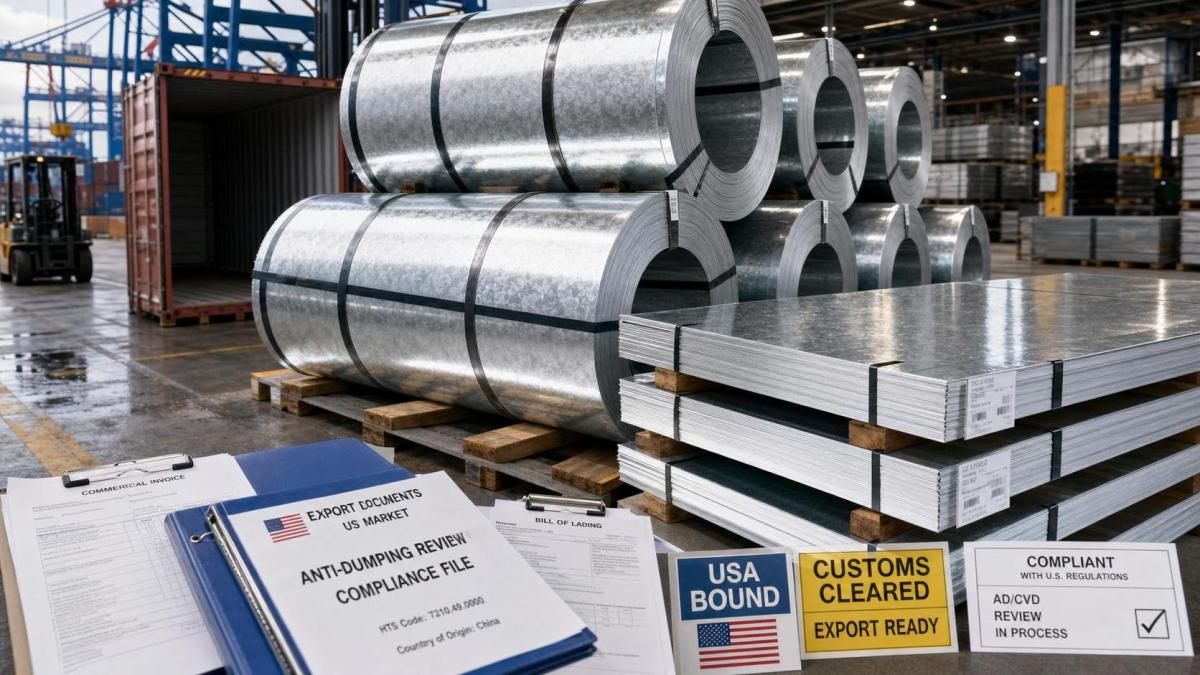
On July 9, 2026, the U.S. Department of Commerce announced the start of a fast-track anti-dumping review covering galvanized steel sheet exported from China under HS 7210.49 and 7212.40. The case requires involved Chinese exporters to complete response registration and submit an initial questionnaire by July 15, creating an immediate compliance and pricing issue for exporters, import-side channel partners, and businesses that rely on stable delivery terms into the U.S. market. The development is worth close industry attention because it is not only a procedural notice; it can directly affect tariff recalculation, export quotations, customs clearance alignment, and distributor access over the next 6 to 12 months.
What the July 9 Notice Confirms
The confirmed facts are limited but commercially significant. The U.S. Department of Commerce issued a notice on July 9, 2026 to formally open a fast-track anti-dumping review concerning galvanized steel sheet exported from China. The products identified in the notice fall under HS 7210.49 and 7212.40. According to the summary provided, Chinese exporters involved in the case are required to complete registration by July 15 and file an initial response. The review will recalculate duty rates, and that recalculation is expected to affect export pricing to the United States, customs compliance, and distributor eligibility during the following 6 to 12 months.
Where the Immediate Pressure May Appear
For exporters shipping into the U.S. market
Analysis shows the most direct impact falls on exporters that are within the scope of the review. Their near-term exposure is tied to filing timing, response completeness, and the consistency of product and shipment documentation. What deserves closer attention is that pricing decisions for upcoming orders may need to account for uncertainty around future duty rates rather than relying only on current commercial terms.
For import-facing distributors and channel partners
Distributors and market-entry partners may be affected because recalculated anti-dumping rates can alter supplier access and landed-cost expectations. From an industry perspective, this makes supplier screening, contract assumptions, and onboarding standards more sensitive. Channel participants will likely need to pay closer attention to product classification, supporting trade documents, and whether upstream exporters remain eligible for continued business under changing compliance conditions.
For procurement and manufacturing users of galvanized steel sheet
Buyers and downstream manufacturers may not be the direct respondents in the review, but they can still face changes in quotation validity, lead-time certainty, and sourcing flexibility. Observably, procurement teams should watch for shifts in offer terms, document requirements linked to customs handling, and the possibility that supplier selection criteria become more compliance-driven during the review period.
For supply chain and customs service providers
Service providers involved in customs filing, documentation control, and shipment coordination may see higher demand for classification accuracy and file readiness. The practical impact is less about a new logistics rule by itself and more about the need for tighter alignment between exporter submissions, shipment records, and clearance documentation where anti-dumping treatment becomes commercially material.
Practical Points Companies Should Monitor Now
Registration and initial filing readiness
Analysis shows the July 15 registration and initial response requirement is the first operational checkpoint. Companies connected to affected exports should confirm whether their products and transactions fall within the stated HS scope and whether internal and external teams are aligned on submission responsibilities and supporting records.
Quotation and contract review for the next 6 to 12 months
Because the review is expected to recalculate duty rates, businesses should pay attention to how current quotations, supply agreements, and delivery commitments are structured. It is more appropriate to understand this as a live trade-risk issue rather than a distant policy topic, especially where margins, validity periods, or distributor commitments assume stable duty treatment.
Document consistency across trade and clearance workflows
What deserves closer attention is the consistency of HS classification, commercial documents, and product-related records used across export, customs, and channel onboarding steps. The input does not provide detailed enforcement mechanics, so it would be premature to describe any final execution model. Still, firms should treat document alignment as an immediate review point.
Distributor access and supplier qualification standards
Observably, the summary links the review to distributor eligibility, which means commercial access may depend not only on price but also on perceived compliance reliability. Exporters and their business partners should therefore watch for changes in qualification checks, onboarding questions, and transaction documentation requests from counterparties serving the U.S. market.
How This Should Be Read at This Stage
From an industry perspective, this development is best read as a concrete execution signal rather than a completed market outcome. The rule-related change is already actionable because the review has been opened and a response deadline has been set. At the same time, the commercial consequences still depend on how the review proceeds and how recalculated rates are eventually reflected in pricing, clearance practice, and channel decisions. Analysis shows the immediate issue is procedural and compliance-driven, while the full market effect remains something to monitor rather than assume.
What This Means for the Market Right Now
The significance of this notice lies in its timing and operational reach. It directly links a trade remedy review to near-term export execution, customs alignment, and distributor access for galvanized steel sheet shipments into the United States. A neutral reading is that the event should currently be understood as an active regulatory and trade-compliance development with short-term business implications, not yet as a settled commercial result. Companies exposed to the affected product scope should therefore focus on filing readiness, transaction documentation, and contract assumptions while continuing to watch for further official clarification.
Basis of This Article and What Still Needs Verification
This article is based on the user-provided news title, event date, and event summary. For developments of this type, market participants would normally monitor source categories such as official government notices, releases from regulatory or trade authorities, customs or trade administration information, industry association updates, standard-setting documents, and reporting by established business media. No specific official source link was provided in the input, so the underlying notice and any later procedural details still need ongoing verification. Further observation should focus on subsequent official wording, execution guidance, customs treatment, distributor practice, and company-level implementation during the review period.