

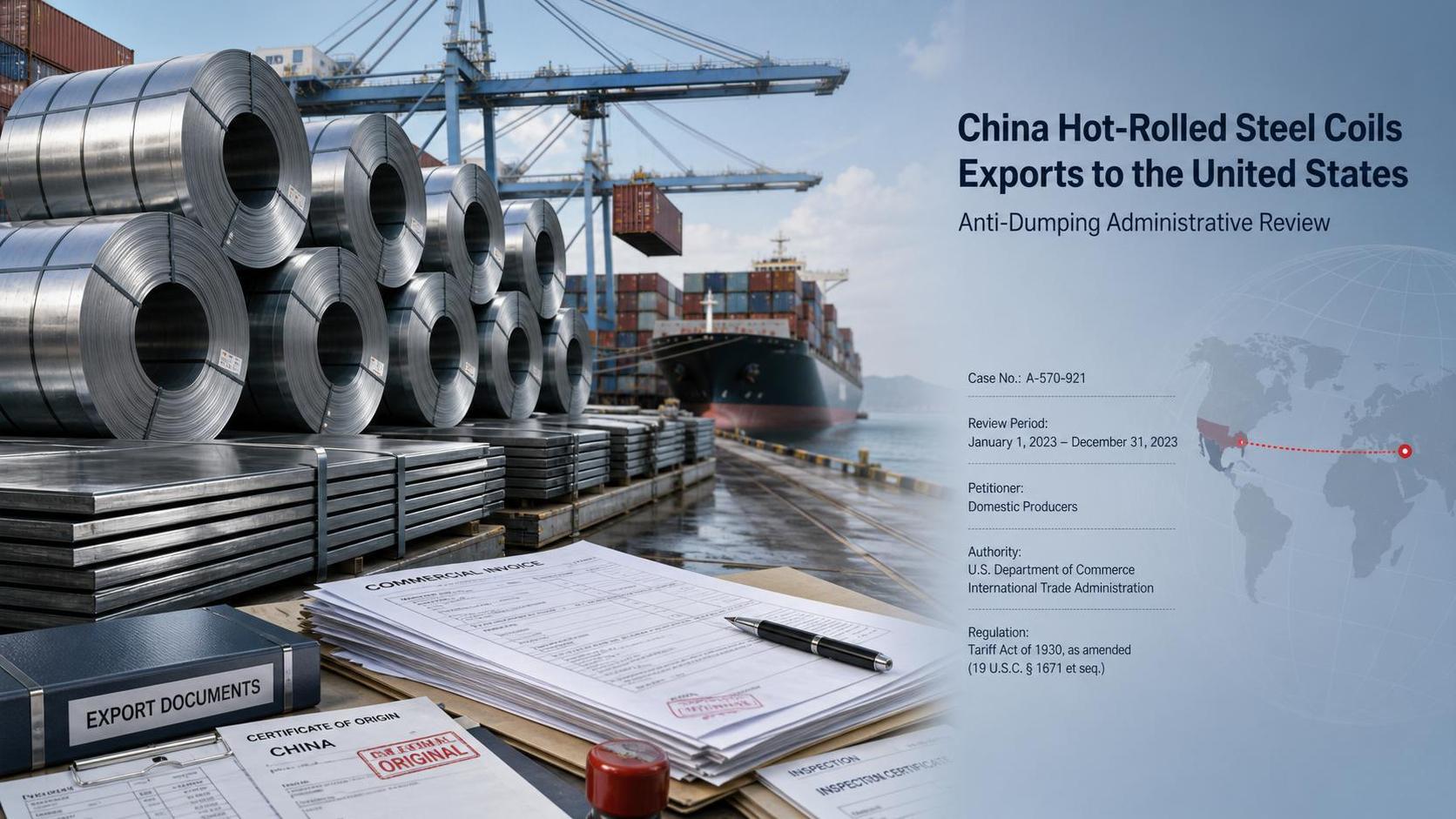
On July 13, 2026, the U.S. Department of Commerce announced the launch of the first annual administrative review of the anti-dumping duty order covering hot-rolled coil from China under HS 7208.51-7208.99. The review covers export shipments from April 1, 2025 to March 31, 2026, and deserves close industry attention because it can affect duty rate application, customs timing, and buyer-side compliance costs over the next 12 months for exporters, import-facing supply chains, and procurement functions tied to this product flow.

What Has Formally Been Put Into Motion
The confirmed facts are limited but commercially significant. The U.S. Department of Commerce formally initiated the first annual administrative review of the anti-dumping duty order on hot-rolled coil of Chinese origin on July 13, 2026, following an application from the domestic industry. The product scope identified in the input covers HS 7208.51 through 7208.99, and the review period covers export batches shipped between April 1, 2025 and March 31, 2026. Based on the information provided, the review will directly affect the duty treatment applicable to exports to the U.S. over the coming 12 months, as well as customs clearance efficiency and compliance costs for purchasers.
Where the Immediate Pressure Points May Appear
For exporters serving the U.S. market
From an industry perspective, exporters are likely to feel the impact first because the review is tied directly to future duty rate application. The most exposed business links are shipment planning, documentation consistency, customs-facing file preparation, and communication with U.S.-side customers. What deserves closer attention is whether internal records for covered shipments within the stated review period are complete, traceable, and aligned with product classification and transaction documents.
For buyers and procurement teams
Procurement functions may be affected because the review can alter cost assumptions and transaction timing even before any broader market response becomes clear. The main pressure points are landed cost calculations, supplier evaluation, delivery scheduling, and contract execution. Analysis shows that buyers handling covered hot-rolled coil should pay attention to trade terms, customs documentation readiness, and any compliance clauses that could shift risk or timing in ongoing or upcoming orders.
For processors, distributors, and downstream users
Processors and distribution channels may not be the direct target of the review, but they can still be affected through pricing pass-through, order timing, and availability planning. Observably, the business risk here is less about the announcement itself and more about whether the review creates delays, additional document checks, or greater caution in cross-border transactions involving the covered product lines.
For logistics and trade compliance service providers
Supply chain service providers, customs-related support teams, and trade compliance advisers may see increased demand for document review and timing coordination. The operational focus is likely to fall on shipment records, product coding alignment, and clearance preparation. It is more appropriate to understand this as a workflow sensitivity issue rather than a confirmed disruption, because the input does not provide a final review outcome or detailed execution measures.
What Companies Should Track From This Point
Review-period shipment records
Companies connected to the covered exports should closely review records tied to shipments made from April 1, 2025 to March 31, 2026. Analysis shows that document completeness across invoices, product descriptions, HS classification references, and shipment files is likely to matter in any compliance or customs-facing follow-up linked to the review.
Customs timing and delivery commitments
Because the provided information states that customs clearance timing may be affected, businesses should monitor whether delivery promises, inventory buffers, or buyer acceptance schedules need adjustment. This should be treated as a practical watchpoint rather than a confirmed delay pattern, since no detailed implementation timetable was provided in the input.
Contract and procurement risk allocation
What deserves closer attention is how existing and pending transactions assign responsibility for duty changes, compliance costs, and shipment timing risk. Buyers and sellers may need to recheck whether current commercial terms remain workable if review-related uncertainty affects cost visibility or order release decisions.
Official wording and later execution signals
The input confirms the launch of the review, but it does not provide detailed downstream procedures, interpretive guidance, or a final outcome. Companies should therefore continue tracking later official wording, practical enforcement signals, and any updates that could influence documentation standards, customs handling, or supplier qualification decisions.
How This Development Is Best Understood Now
Observation rather than conclusion is the appropriate frame at this stage. This development already signals an active trade remedy process with direct commercial relevance, so it should not be treated as a symbolic notice. At the same time, it would be premature to read it as a fully settled cost or market outcome, because the input only confirms the initiation of the annual review and its covered period. From an industry perspective, the key significance lies in execution risk: duty treatment, clearance rhythm, and compliance cost exposure may all become more sensitive during the next phase.
A Practical Reading of the Current Situation
The industry significance of this announcement is not simply that a review has begun, but that a formal rule-based process is now shaping near-term trade handling for Chinese-origin hot-rolled coil entering the U.S. market. Analysis shows that this is best understood as an implemented regulatory signal with immediate operational relevance, while the full commercial effect still requires continued observation. For companies across export, procurement, processing, and logistics functions, the current task is to watch execution details closely rather than assume a fixed outcome too early.
Basis of This Article and What Still Needs Verification
This article is based on the user-provided news title, event date, and event summary. For developments of this kind, relevant source categories typically include official notices, releases from regulatory authorities, customs or trade administration information, industry association updates, standard-setting documents, and reporting from authoritative media. The specific official source link was not provided in the input, so continued verification remains necessary. What still needs to be monitored includes later policy detail, execution interpretation, customs handling practice, procurement document changes, industry feedback, and how affected companies implement their compliance and delivery arrangements.