


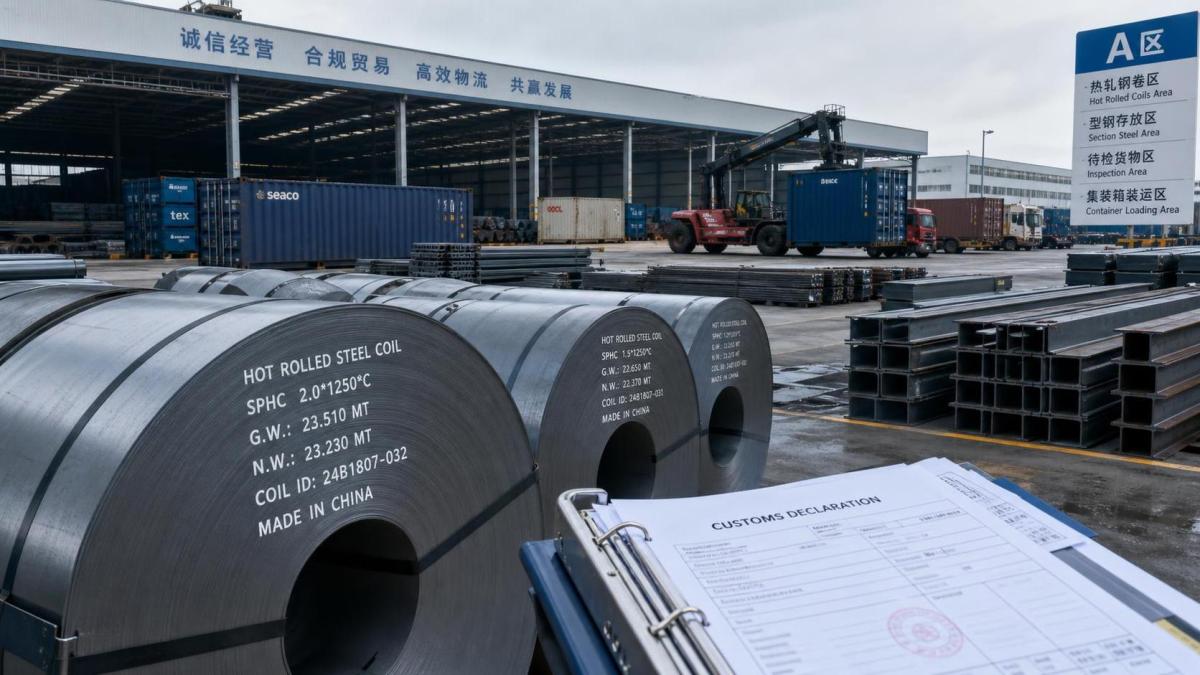
On August 8, 2026, the U.S. Department of Commerce opened a combined anti-dumping (AD) and countervailing duty (CVD) investigation into hot-rolled steel coil exports from China under HS 7208, 7210, and 7211. For companies tied to the North American steel market, this is not only a trade case update but also a compliance and procurement signal, because it may affect import procedures, landed cost visibility, and supply continuity across steel distribution and downstream manufacturing, including applications linked to carbon steel sections, structural steel, and cold-rolled feedstock.
What has been formally initiated
The confirmed facts are limited but material. The U.S. Department of Commerce formally accepted the case on August 8, 2026, and launched both an AD and a CVD investigation covering Chinese exports of hot-rolled steel coil classified under HS 7208, 7210, and 7211. The preliminary determination is expected in December 2026. The case directly concerns procurement compliance, customs cost exposure, and supply chain stability for steel importers, distributors, and end manufacturers in the North American market.
Where pressure may appear across the supply chain
Import purchasing may face immediate compliance review
From an industry perspective, importers of covered steel products may be among the first to feel the effect because the opening of an AD/CVD case usually changes how procurement decisions are assessed internally. What deserves closer attention is whether current and pending shipments, product classifications, and transaction records are sufficiently clear for customs and trade review. Even before any preliminary result is released, purchasing teams may need to pay closer attention to product scope, HS coding consistency, and document readiness tied to import declarations and contract execution.
Distributors may need to reassess inventory and quote discipline
For distributors serving the North American market, the main pressure point is likely to be commercial execution rather than production. Analysis shows that when a trade investigation formally begins, quotation validity, resale commitments, and inventory turnover assumptions may all require closer internal control. The practical issue is not that an outcome has already been decided, but that cost predictability and customs treatment may become less certain during the investigation period.
Downstream manufacturers may need to revisit supply continuity
End users in applications such as carbon steel sections, structural steel, and cold-rolled feedstock may need to pay closer attention to delivery planning and material sourcing assumptions. Observably, manufacturers that rely on imported steel inputs can be affected through procurement timing, supplier qualification review, and lead-time management. This is especially relevant where steel input availability affects fabrication schedules, order commitments, or technical material substitution decisions.
Supply chain service providers may see higher documentation sensitivity
Logistics, customs, and trade service participants may also need to adjust their review focus. What deserves closer attention is the completeness and consistency of shipment documents, technical descriptions, and transaction files associated with covered products. The event points to a period in which documentation quality may matter more in daily execution, especially where customs clearance cost and timing are sensitive to product identification and declared trade details.
Practical watchpoints before the preliminary decision
Keep product scope and classification records clean
Analysis shows that companies involved with HS 7208, 7210, and 7211 should review whether internal product descriptions, contract wording, and customs-facing classifications are aligned. The immediate value of this work is procedural: it helps reduce confusion in procurement, clearance, and internal risk review while the investigation remains active.
Track official wording and procedural updates closely
It is more appropriate to understand this case as an active regulatory process rather than a settled trade outcome. Companies should therefore monitor how official language develops around the investigation, including any later statements that may influence execution, interpretation, or case scope. At this stage, the input does not provide detailed implementation rules, so any operational response should remain watchful rather than assume a final result.
Review contracts, lead times, and supplier communication
For buyers and sellers, a practical near-term task is to check whether delivery schedules, pricing assumptions, and sourcing arrangements remain workable if customs cost or clearance timing becomes less predictable. Observably, this is less about broad management strategy and more about concrete trade execution: shipment timing, procurement sequencing, and communication discipline with suppliers and customers.
Prepare supporting files for traceability and trade review
Companies connected to covered products may also want to verify the availability of technical documents, transaction records, and other supporting materials that help explain the nature and use of the goods. The input does not confirm any new filing requirement, so this should be treated as a risk-management step rather than a mandatory new rule already in force.
Why this reads as an execution signal, not a final outcome
Observably, the current development is best read as a clear enforcement and compliance signal. The investigation has been formally initiated, which is already meaningful for procurement controls and customs-facing decision-making. At the same time, the preliminary decision is only expected in December 2026, so the market does not yet have a confirmed final direction from this case. From an industry perspective, that means companies should avoid treating uncertainty as settled policy, while also avoiding the opposite mistake of assuming the case has no immediate operational relevance.
How the market may need to frame this development now
The significance of this event lies in its effect on trade-sensitive steel transactions rather than in any confirmed final penalty at this stage. It points to a period of closer scrutiny for imports of covered hot-rolled steel coil from China and for the downstream businesses that depend on those flows. It is more appropriate to understand this development as a live rule-driven change in market execution conditions, with further observation still required on official determinations, implementation language, and commercial reaction across the supply chain.
Basis of this article and what still requires verification
This article is based on the user-provided news title, event date, and event summary. For events of this kind, relevant source categories commonly include official government notices, releases from regulatory authorities, customs or trade administration information, industry association updates, standard-setting documents, and reporting from authoritative media. A specific official source link was not provided in the input, so subsequent verification remains necessary. What still requires continued observation includes later official wording, implementation interpretation, procurement and bidding document changes, industry feedback, and how affected companies adjust actual execution during the investigation period.