


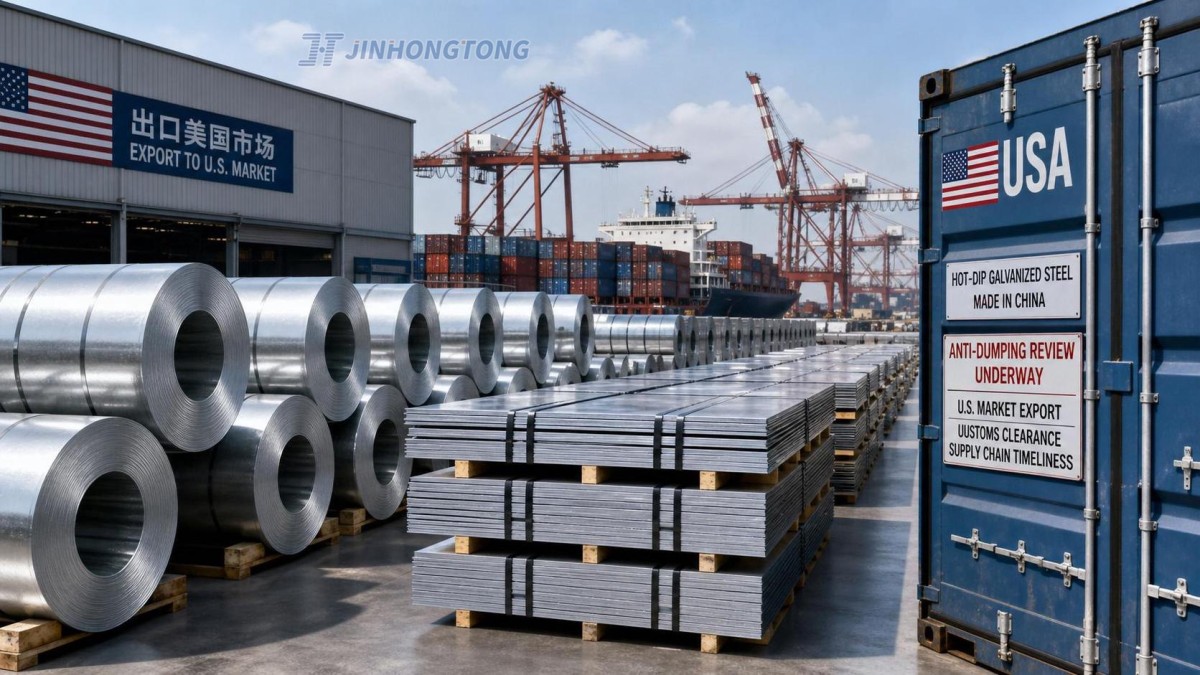
On July 5, 2026, the U.S. Department of Commerce announced the start of an administrative review of anti-dumping measures on hot-dip galvanized steel sheet from China under HS 7210.49 and 7212.40. The review covers export shipments made from April 1, 2025 to March 31, 2026, and it matters because its timing reaches directly into pricing, cash-deposit planning, customs clearance, and document readiness for shipments to the U.S. from the third quarter of 2026 onward. Exporters, importers, manufacturers, traders, and supply chain service providers all need to treat this as an operational trade-rule development rather than a routine headline.
What the notice confirms at this stage
The confirmed facts are limited but commercially important. The U.S. Department of Commerce issued the notice on July 5, 2026 and initiated an anti-dumping administrative review covering Chinese hot-dip galvanized steel sheet classified under HS 7210.49 and 7212.40. The review period runs from April 1, 2025 to March 31, 2026. Based on the event summary provided, the review will directly affect pricing strategy for shipments to the U.S. starting in the third quarter of 2026, the handling of cash-deposit requirements, and customs clearance timing. Importers are also expected to verify certificates of origin and cost-composition documents in advance.
Where the pressure is likely to appear first
Export contract execution will face closer trade-rule scrutiny
From an industry perspective, exporters are likely to feel the first impact in quotation management, shipment scheduling, and contract execution. The reason is straightforward: once an administrative review is underway, pricing assumptions for future U.S.-bound shipments may need to account for possible changes in duty exposure and clearance timing. What deserves closer attention is not only the sales price itself, but also the supporting trade documents tied to origin and cost structure.
Import-side document checks become more practical than procedural
For importers and procurement teams, the review raises the practical importance of document validation before cargo moves. The event summary specifically points to advance verification of certificates of origin and cost-composition files. That means the impact is not limited to trade compliance teams; purchasing, customs brokers, and internal finance functions may also need tighter coordination to avoid delays once goods arrive for clearance.
Processing and manufacturing links may need better traceability support
Manufacturers and processors involved in the supply chain may be affected through requests for clearer product classification, origin support, and cost records. Analysis shows that when a review influences pricing and customs timing, upstream production records and cost documentation can become more important in downstream trade decisions. This does not confirm any new documentation rule beyond the information provided, but it does indicate that traceability may become a more sensitive point in commercial execution.
Logistics and trade service providers may need to adjust timing assumptions
Supply chain service providers, including forwarding and customs-support functions, may see the impact in delivery planning and clearance coordination. Observably, when review activity is expected to affect customs timing, service providers need to watch for schedule compression, document rechecks, and last-minute adjustments around shipment release. The operational issue here is not a confirmed change in logistics rules, but the increased sensitivity of customs handling under a live trade-remedy review.
What companies should watch in the coming weeks
Keep origin and cost files ready for transaction-level review
Companies involved in U.S.-bound shipments should review whether origin documentation and cost-composition records are complete, internally consistent, and aligned with the traded product under HS 7210.49 and 7212.40. Based on the provided summary, this is one of the most immediate compliance points.
Recheck Q3 pricing assumptions before shipment release
Because the review is described as directly affecting pricing strategy from the third quarter of 2026, exporters and importers should closely examine whether current quotations, contract terms, and deposit-related assumptions still reflect the trade environment signaled by the review. This is an execution concern, not a confirmed outcome, so companies should avoid treating any single pricing scenario as settled.
Build more time into customs and delivery planning
The summary indicates possible effects on customs clearance timing. Analysis shows that businesses with tight delivery windows, fixed procurement schedules, or back-to-back shipment commitments should pay closer attention to document completeness and internal approval speed. The key issue is preparedness for timing friction rather than any confirmed uniform delay.
Follow official language and market practice before making structural changes
No detailed execution outcome is provided in the input, so companies should avoid overreacting with broad sourcing or market changes based only on the initiation notice. What deserves closer attention is how official wording, transaction practice, and counterpart requirements evolve after the review has started.
Why this reads more as an execution signal than a final outcome
Analysis shows that this development is better understood as a live execution signal in trade compliance and order management, rather than a completed rule change with fully known commercial consequences. The confirmed facts already point to effects on pricing, deposits, and clearance timing, which is enough to influence near-term behavior. At the same time, the input does not provide a final review result, a new duty determination, or a detailed enforcement framework. For that reason, the market should read this as an actionable compliance and transaction signal that still requires continued observation.
How to interpret the development at this point
At this stage, the industry significance lies in the fact that a formal anti-dumping administrative review has moved from background risk to an active operating factor for U.S.-bound galvanized steel trade. A rational reading is that the event already matters for documentation, pricing discipline, and shipment planning, especially for orders linked to the third quarter of 2026. It is more appropriate to understand this as a rule-driven operational change with immediate practical implications, while the full commercial impact still needs to be observed through subsequent execution and market response.
Basis of this article and what still needs verification
This article is generated from the user-provided news title, event date, and event summary. For events of this type, commonly relevant source categories include official notices, releases from regulatory authorities, customs or trade-administration information, industry association updates, standard-setting documents, and reporting by authoritative media. A specific official source link was not provided in the input, so it still needs to be verified on an ongoing basis. What also remains worth monitoring includes later official wording, implementation practice, document review expectations, changes in procurement or tender requirements, industry feedback, and how companies actually adjust shipment and compliance processes.