


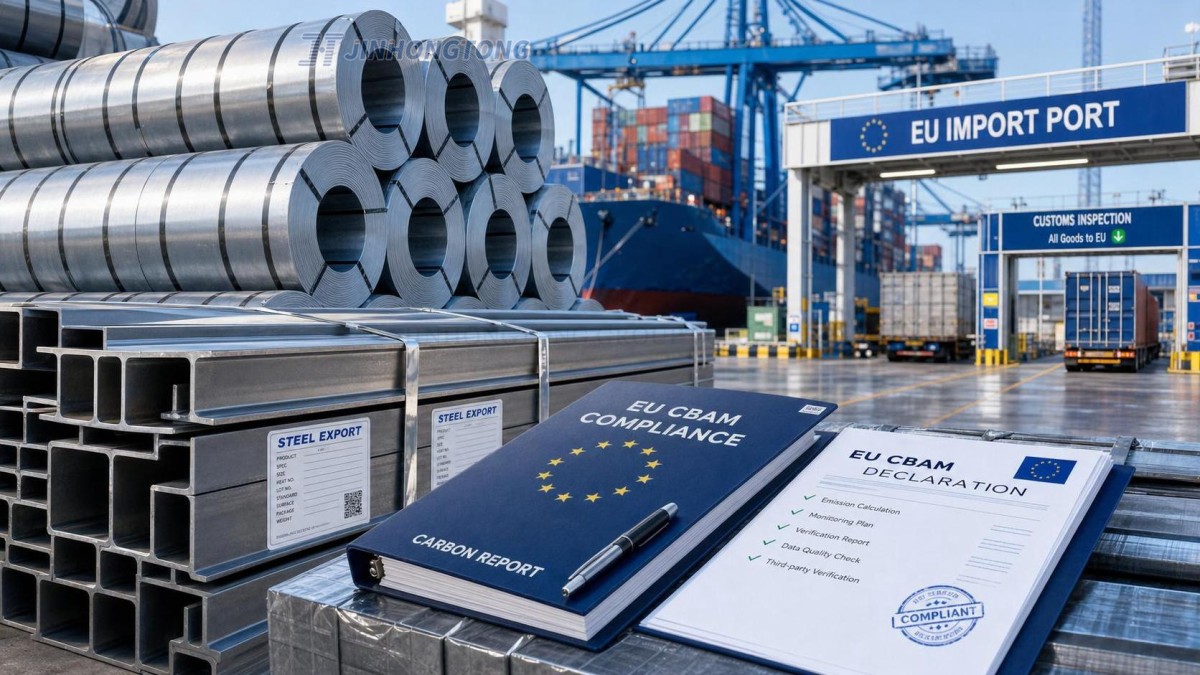
From June 1, 2026, the EU Carbon Border Adjustment Mechanism (CBAM) moves into regular enforcement for all steel import declarations, making carbon compliance a direct trade requirement rather than a preparatory issue. For steel exporters, importers, and supply-chain service providers involved in China-Europe trade, the development deserves close attention because customs clearance now depends not only on product delivery, but also on certified embedded emissions data, CBAM certificate purchases, and supporting documentation such as EPDs and carbon accounting explanations.
What Has Officially Changed in Steel Trade Procedures
According to the provided information, CBAM enters its normalized enforcement stage from June 2026 and applies to all steel product import declarations into the EU. Exporters are required to submit certified embedded carbon emissions data and purchase the corresponding number of CBAM certificates. If declarations are not compliant, the result may be customs delays or refusal of entry. The same information also states that the mechanism has already affected the pace of China-Europe steel trade, while importers in several countries are asking Chinese suppliers to provide Environmental Product Declarations (EPDs) and explanations of their carbon accounting methodology in advance.
Where the Pressure Now Appears Across the Chain
Export transactions are becoming documentation-sensitive
From an industry perspective, direct trading companies are likely to feel the impact first because they sit at the point where shipment, declaration, and customer compliance demands meet. The immediate pressure is not limited to product pricing or scheduling; it also extends to whether carbon data can be prepared, certified, and matched to the declared goods in time for clearance.
Manufacturers face closer scrutiny on emissions records
Analysis shows that processing and manufacturing enterprises supplying steel products may be affected through customer requests for verified embedded emissions data, EPDs, and a clear accounting pathway. In practical terms, the issue shifts part of market access preparation upstream, as suppliers may need to support buyers with more structured environmental documentation before orders move forward.
Importers and buyers are tightening pre-shipment requirements
Observably, overseas importers are no longer only checking product specifications and delivery terms. They are also asking Chinese suppliers to provide carbon-related supporting materials earlier in the transaction process. This means purchasing decisions, supplier approval, and order confirmation may increasingly depend on whether the required compliance package can be produced reliably.
Supply-chain service providers may see new coordination risks
For logistics, customs, and related service participants, the impact may appear in the form of longer coordination cycles and higher sensitivity around missing or inconsistent declarations. What deserves closer attention is that a customs issue under CBAM may affect shipment timing, handover planning, and communication between exporter, importer, and intermediary service teams.
What Companies Should Watch Right Now
Whether product-level carbon data is ready for submission
Analysis shows that the key operational question is not only whether a company understands CBAM in principle, but whether it can provide certified embedded emissions data in a form acceptable for actual import declaration. Firms involved in steel exports should pay close attention to document readiness, internal data consistency, and response speed when customers request proof.
How EPD requests are entering commercial discussions
The provided information indicates that importers in multiple countries are already asking for EPDs and explanations of carbon accounting pathways in advance. Companies should therefore monitor whether these requests appear at quotation stage, contract stage, or pre-shipment stage, because the timing will affect internal coordination and delivery planning.
The gap between policy wording and shipment execution
From an industry perspective, one practical issue is the difference between knowing the rule and executing against it in live trade. Even where counterparties generally understand the requirement, the actual risk may emerge when product documents, emissions data, certification status, and declaration timing do not align. That makes cross-functional coordination a more immediate concern than abstract policy awareness.
Customer communication and contingency planning
Observably, the risk of customs delay or refusal makes advance communication more important for exporters and suppliers. What deserves closer attention is whether buyers have already updated their documentation expectations, and whether sellers have a fallback process when carbon-related materials are incomplete or still under review.
Why This Looks Like More Than a Short-Term Adjustment
Analysis shows that this development is better understood as a structural compliance signal within steel trade rather than a temporary procedural fluctuation. The reason is that the mechanism now ties customs treatment to carbon reporting and certificate obligations in a direct way. At the same time, it remains important to distinguish confirmed facts from broader market conclusions: the provided information confirms enforcement, documentation requirements, and visible trade effects, but the full scale of longer-term commercial impact still requires continued observation.
How to Read the Signal at This Stage
It is more appropriate to understand this event as a clear transition from policy preparation to operational enforcement in EU-related steel trade. For the industry, the immediate significance lies in compliance execution, document credibility, and transaction readiness. A measured conclusion is that carbon accounting is moving closer to the core of delivery and customs performance for steel exporters, while the broader commercial consequences should continue to be assessed through actual order flows, buyer requirements, and declaration practice.
Basis of This Article and What Still Needs Verification
This article is generated based on the user-provided news title, event date, and event summary. For this type of development, commonly relevant source categories may include official announcements, company disclosures, industry association updates, authoritative media reporting, and standard-setting organization documents. No specific official source link was provided in the input, so further verification remains necessary. Continued attention should focus on any updated official wording, import-side implementation details, and how customer documentation requirements evolve in actual steel trade transactions.